
Temperature is something we deal with every day, whether we’re checking the weather forecast, following a cooking recipe, traveling abroad, or studying science. Yet one simple difference often creates confusion: some countries use Fahrenheit, while most of the world uses Celsius.
If you’ve ever wondered how to convert fahrenheit to celsius without making mistakes, you’re in the right place. Although the calculation may look intimidating at first, it’s actually straightforward once you understand the formula and the logic behind it.
In this comprehensive guide, you’ll learn the exact conversion formula, practical shortcuts, real-world examples, conversion tables, common mistakes, and expert tips for accurate temperature conversion. By the end of this article, converting fahrenheit to celsius will feel almost effortless.
Understanding Fahrenheit and Celsius
Before learning the conversion process, it’s helpful to understand these two temperature scales.
What Is Fahrenheit?
The Fahrenheit scale was developed by German physicist Daniel Gabriel Fahrenheit in the early 1700s. It remains the primary temperature scale used in the United States and a few other regions.
Key reference points include:
- Water freezes at 32°F
- Water boils at 212°F
- Normal human body temperature is approximately 98.6°F
Many weather forecasts, thermostats, and cooking instructions in the United States rely on the Fahrenheit scale.
What Is Celsius?
Celsius, also known as the centigrade scale, is the world’s most widely used temperature scale. Scientists and nearly every country outside the United States use Celsius because of its simple relationship with water.
Important reference temperatures include:
- Water freezes at 0°C
- Water boils at 100°C
- Comfortable room temperature is about 20–22°C
Because Celsius is part of the metric system, it’s commonly used in education, healthcare, weather reporting, laboratories, and engineering.
Why You Need to Convert Fahrenheit to Celsius
There are countless situations where knowing how to convert fahrenheit to celsius becomes useful.
For example:
- Traveling internationally
- Reading weather forecasts abroad
- Following international recipes
- Understanding scientific research
- Medical temperature readings
- School assignments
- Laboratory experiments
- Engineering calculations
- Climate studies
- Home thermostat adjustments
Instead of guessing what a temperature means, accurate conversion provides clarity.
The Formula for Fahrenheit to Celsius
The standard formula is surprisingly simple.
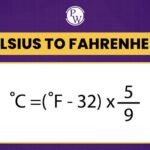
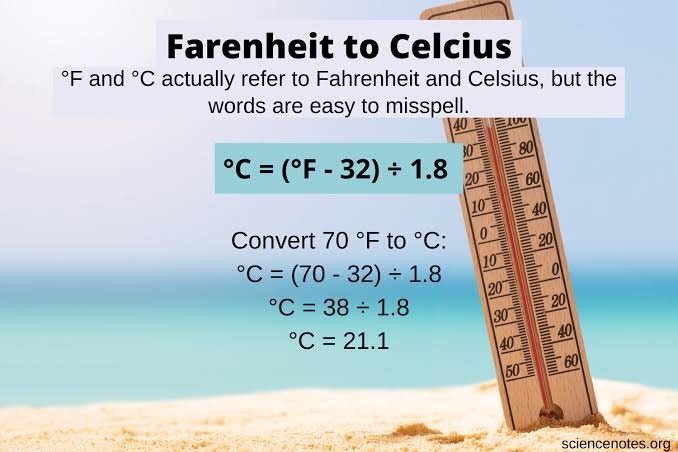
Celsius = (Fahrenheit − 32) × 5 ÷ 9
This formula works for every temperature.
Let’s break it down.
Step 1
Subtract 32 from the Fahrenheit temperature.
Step 2
Multiply the answer by 5.
Step 3
Divide the result by 9.
That’s it.
Example 1: Convert 68°F
Let’s calculate it together.
68 − 32 = 36
36 × 5 = 180
180 ÷ 9 = 20
68°F = 20°C
Example 2: Convert 95°F
95 − 32 = 63
63 × 5 = 315
315 ÷ 9 = 35
95°F = 35°C
Example 3: Convert 32°F
32 − 32 = 0
0 × 5 = 0
0 ÷ 9 = 0
32°F = 0°C
This makes sense because water freezes at both temperatures.
Example 4: Convert 212°F
212 − 32 = 180
180 × 5 = 900
900 ÷ 9 = 100
212°F = 100°C
Again, this matches the boiling point of water.
Fahrenheit to Celsius Conversion Table
| Fahrenheit (°F) | Celsius (°C) |
|---|---|
| -40 | -40 |
| -20 | -28.9 |
| 0 | -17.8 |
| 10 | -12.2 |
| 20 | -6.7 |
| 32 | 0 |
| 40 | 4.4 |
| 50 | 10 |
| 60 | 15.6 |
| 68 | 20 |
| 70 | 21.1 |
| 80 | 26.7 |
| 90 | 32.2 |
| 95 | 35 |
| 98.6 | 37 |
| 100 | 37.8 |
| 104 | 40 |
| 120 | 48.9 |
| 150 | 65.6 |
| 212 | 100 |
Keeping this chart nearby can save time when performing quick conversions.
A Quick Trick for Estimating Fahrenheit to Celsius
Sometimes you don’t need an exact answer.
A quick estimate works well.
Subtract 30 from the Fahrenheit temperature, then divide by 2.
For example:
80°F
80 − 30 = 50
50 ÷ 2 = 25°C
The exact answer is 26.7°C.
The estimate is close enough for everyday conversations.
When Accuracy Really Matters
Although estimation is convenient, precise conversion is essential in several situations.
Medical Temperatures
A fever reading should always be converted accurately.
For instance:
- 98.6°F = 37°C
- 100.4°F = 38°C
- 102.2°F = 39°C
Doctors and healthcare professionals rely on exact values.
Scientific Research
Laboratories require accurate temperature measurements for experiments.
Even a small difference can affect results.
Cooking and Baking
Many international recipes list oven temperatures in Celsius.
Incorrect conversion can change cooking times and food quality.
Industrial Applications
Manufacturing, engineering, chemistry, and physics all require precise temperature conversion for safety and quality control.
Common Fahrenheit Values Explained
32°F
Water freezes.
Roads may become icy.
50°F
A cool day.
Most people wear a light jacket.
68°F
Comfortable indoor temperature.
77°F
Pleasant warm weather.
86°F
A hot summer day.
95°F
Very hot conditions.
Hydration becomes important.
104°F
Extreme heat.
Outdoor activity should be limited.
Common Mistakes When Converting Fahrenheit to Celsius
Even though the formula is simple, mistakes happen.
Forgetting to Subtract 32
Many people multiply first.
Always subtract 32 before anything else.
Dividing Before Multiplying
Follow the correct order.
Subtract.
Multiply.
Divide.
Rounding Too Early
Round only after completing the calculation.
Early rounding reduces accuracy.
Mixing Temperature Scales
Always verify whether a number is in Fahrenheit or Celsius before converting.
Easy Mental Benchmarks
Memorizing a few temperatures helps with quick estimation.
| Fahrenheit | Celsius |
| 32°F | 0°C |
| 50°F | 10°C |
| 68°F | 20°C |
| 86°F | 30°C |
| 104°F | 40°C |
| 212°F | 100°C |
These reference points become surprisingly useful over time.
Practical Uses of Fahrenheit to Celsius Conversion
Learning fahrenheit to celsius isn’t just for students.
It has many everyday applications.
Weather Forecasts
Travelers often need to understand local temperatures.
Air Conditioning
Many thermostats allow switching between Fahrenheit and Celsius.
Cooking
Recipes from different countries frequently use different temperature scales.
Education
Students encounter both systems in mathematics and science.
Healthcare
Hospitals worldwide commonly record temperatures in Celsius.
International Business
Companies operating globally often convert temperature specifications for equipment and products.
Benefits of Learning the Conversion Formula
Knowing how to convert fahrenheit to celsius offers several advantages.
- Better understanding of international weather
- Improved cooking accuracy
- Easier travel planning
- Greater scientific knowledge
- Stronger math skills
- Increased confidence when reading temperature data
- Better communication across countries
Expert Tips for Faster Conversion
If you frequently convert temperatures, these habits can save time.
- Memorize freezing and boiling points.
- Learn common room temperatures.
- Practice with weather forecasts.
- Use estimation for casual conversations.
- Use the exact formula for science and medicine.
- Keep a conversion chart nearby.
- Double-check decimal values.
- Avoid rounding until the end.
With regular practice, converting fahrenheit to celsius becomes second nature.
Related Temperature Terms You Should Know
Understanding these terms makes temperature conversion even easier.
- Temperature scale
- Degrees Fahrenheit
- Degrees Celsius
- Metric system
- Imperial system
- Thermometer
- Digital thermometer
- Weather forecast
- Climate
- Heat
- Cold
- Freezing point
- Boiling point
- Room temperature
- Body temperature
- Fever
- Absolute zero
- Water freezing
- Water boiling
- Temperature measurement
- Temperature calculator
- Conversion formula
- Temperature chart
- Conversion table
- Celsius formula
- Fahrenheit formula
- Temperature difference
- Scientific measurement
- Laboratory temperature
- Weather temperature
- Air temperature
- Outdoor temperature
- Indoor temperature
- Cooking temperature
- Oven temperature
- Baking temperature
- Climate data
- Meteorology
- Physics
- Chemistry
- Engineering
- Thermal energy
- Heat transfer
- Temperature conversion calculator
- Unit conversion
- Measurement system
- International temperature scale
- Weather apps
- Climate science
- Digital weather station
- Environmental temperature
- Daily forecast
- Temperature reading
- Temperature units
- Temperature guide
- Temperature reference
- Celsius conversion
- Fahrenheit conversion
- Exact conversion
- Accurate calculation
- Formula method
- Temperature examples
- Conversion practice
- Temperature values
Conclusion
Learning how to convert fahrenheit to celsius is a practical skill that benefits everyone—from travelers and students to home cooks and professionals. Once you understand the simple formula of subtracting 32, multiplying by 5, and dividing by 9, the process becomes quick and reliable.
Throughout this guide, we’ve explored the science behind both temperature scales, worked through step-by-step examples, highlighted common mistakes, shared handy estimation tricks, and provided conversion tables for everyday use. Whether you’re checking the weather, reading a medical thermometer, preparing an international recipe, or working on a science project, accurate fahrenheit to celsius conversion ensures you always interpret temperatures correctly.