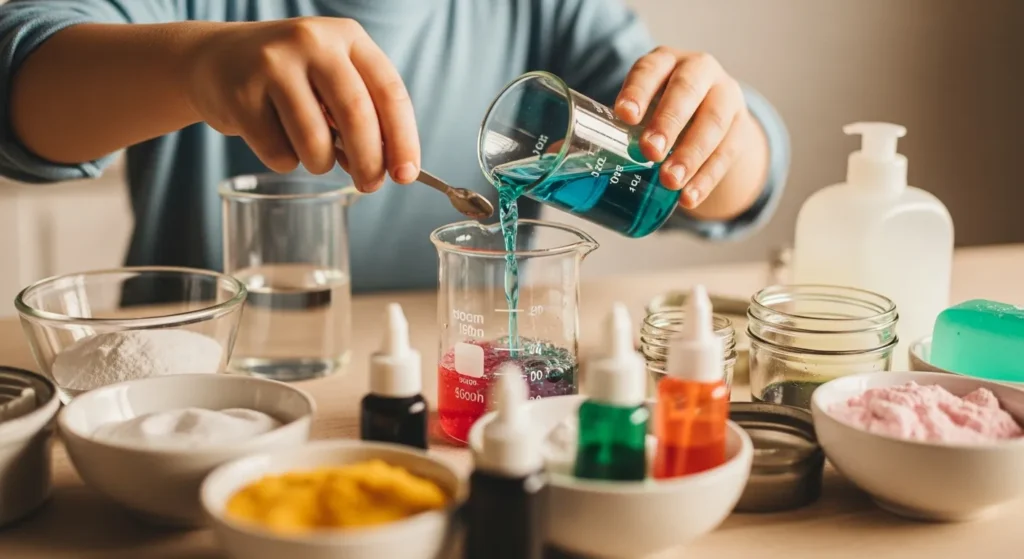

Why Chemistry Experiments Matter
Before jumping into the activities, it’s worth understanding why chemistry experiments are so useful.
Reading about science is one thing. Seeing a chemical reaction happen in front of your eyes is completely different. It creates curiosity. It makes learning memorable. In addition, practical experiments improve observation skills and critical thinking.
Children especially benefit from simple science projects because they encourage creativity and problem-solving. Adults, however, often enjoy them just as much because they reveal the hidden science behind everyday life.
These chemistry experiments can help you understand:
- Acids and bases
- Chemical reactions
- Density
- Surface tension
- Gas formation
- Oxidation
- Temperature changes
- States of matter
- Molecular behavior
- Color reactions
Most importantly, they make science feel fun instead of intimidating.
Safety Tips Before Starting
Even beginner-friendly chemistry experiments require basic safety precautions.
Always Remember These Rules
- Wear old clothes or an apron
- Use safety glasses when possible
- Never taste chemicals
- Wash your hands after experiments
- Work in a clean, open space
- Keep experiments away from pets and very small children
- Follow instructions carefully
These home experiments are designed to be safe, but responsible handling still matters.
1. The Classic Baking Soda Volcano
Few chemistry experiments are as iconic as the baking soda volcano. It’s simple, dramatic, and perfect for beginners.
What You Need
- Baking soda
- Vinegar
- Dish soap
- Food coloring
- Small container or bottle
Instructions
- Place the container on a tray.
- Add a few spoonfuls of baking soda.
- Mix in dish soap and food coloring.
- Pour vinegar into the container.
Suddenly, foamy lava erupts everywhere.
The Science Behind It
This experiment demonstrates an acid-base reaction. Vinegar contains acetic acid, while baking soda is sodium bicarbonate. When combined, they create carbon dioxide gas.
The gas forms bubbles, causing the eruption effect.
Why People Love It
- Fast results
- Cheap materials
- Excellent visual reaction
- Great for science fair projects
2. Rainbow Milk Experiment
This colorful activity is one of the most visually satisfying chemistry experiments for kids and adults alike.
Supplies
- Whole milk
- Food coloring
- Dish soap
- Cotton swab
Steps
- Pour milk into a shallow dish.
- Add drops of food coloring.
- Dip a cotton swab into dish soap.
- Touch the center of the milk.
The colors instantly begin swirling around like tiny fireworks.
What’s Happening?
Milk contains fat molecules. Dish soap breaks apart those fat molecules, creating movement across the surface.
This experiment demonstrates surface tension and molecular interaction.
3. Homemade Slime
Slime remains one of the most popular DIY chemistry experiments because it combines science with creativity.
Materials
- White glue
- Baking soda
- Contact lens solution
- Food coloring
Directions
- Pour glue into a bowl.
- Add food coloring.
- Stir in baking soda.
- Slowly add contact solution until slime forms.
Scientific Explanation
Slime forms through polymer chemistry. The ingredients create long molecular chains that stretch and bend without breaking easily.
Children especially enjoy this experiment because it feels like both a toy and a science lesson.
4. Invisible Ink Experiment
This experiment feels almost magical.
Items Needed
- Lemon juice
- Cotton swab
- White paper
- Lamp or iron
How to Do It
- Dip the swab into lemon juice.
- Write a secret message.
- Let the paper dry completely.
- Heat the paper carefully.
The hidden writing slowly appears.
The Chemistry
Lemon juice contains carbon compounds that oxidize when heated. As they react with heat, they turn brown faster than the paper around them.
This simple experiment demonstrates oxidation reactions.
5. Dancing Raisins
This is one of those chemistry experiments that surprises almost everyone the first time.
Supplies
- Clear soda
- Glass
- Raisins
Instructions
Drop raisins into soda and watch them move up and down repeatedly.
Why It Happens
Carbon dioxide bubbles attach to the raisins and lift them upward. Once the bubbles pop at the surface, the raisins sink again.
It’s a brilliant example of gas behavior and buoyancy.
6. Growing Crystal Structures
Crystal-growing activities are among the most educational chemistry experiments for students.
Materials
- Salt or sugar
- Hot water
- Jar
- String
Method
- Dissolve large amounts of salt or sugar in hot water.
- Pour the solution into a jar.
- Hang a string into the liquid.
- Wait several days.
Crystals slowly begin forming.
Science Explanation
As water evaporates, dissolved particles gather into organized crystal structures.
This experiment teaches patience while showing how minerals naturally form.
7. DIY Lava Lamp
You don’t need expensive kits for entertaining chemistry experiments.
What You Need
- Vegetable oil
- Water
- Food coloring
- Alka-Seltzer tablet
- Clear bottle
Steps
- Fill the bottle mostly with oil.
- Add water and food coloring.
- Drop in part of an Alka-Seltzer tablet.
Colorful blobs begin floating around the bottle.
What Causes It?
Oil and water have different densities and do not mix. The tablet creates carbon dioxide bubbles that carry colored water upward.
This experiment demonstrates density and gas formation.
8. Egg in Vinegar Experiment
This is one of the easiest chemistry experiments with dramatic results.
Supplies
- Raw egg
- Vinegar
- Glass container
Process
- Place the egg into the container.
- Cover it completely with vinegar.
- Wait 24 to 48 hours.
The shell disappears, leaving behind a rubbery egg.
The Chemical Reaction
Eggshells contain calcium carbonate. Vinegar reacts with it, releasing carbon dioxide and dissolving the shell.
Kids are usually amazed when the egg bounces slightly afterward.
9. Homemade pH Indicator
This experiment turns your kitchen into a science lab.
Materials
- Red cabbage
- Hot water
- Cups
- Various liquids
Instructions
- Soak chopped cabbage in hot water.
- Strain the purple liquid.
- Pour it into cups.
- Add substances like lemon juice, soap, or baking soda.
Different colors appear depending on acidity.
The Science
Red cabbage contains anthocyanins, which change color depending on pH levels.
This is one of the best chemistry experiments for understanding acids and bases.
10. Exploding Sandwich Bag
This experiment creates excitement almost instantly.
Supplies
- Baking soda
- Vinegar
- Sandwich bag
- Tissue
Directions
- Pour vinegar into the bag.
- Wrap baking soda in tissue.
- Drop it inside and seal quickly.
The bag inflates and pops.
Scientific Principle
The acid-base reaction creates carbon dioxide gas faster than the bag can contain it.
It’s loud, messy, and memorable.
The Educational Benefits of Home Chemistry Experiments
Many parents underestimate how valuable these activities can be.
Simple chemistry experiments encourage:
| Skill | Benefit |
|---|---|
| Observation | Improves attention to detail |
| Problem-solving | Builds logical thinking |
| Creativity | Encourages experimentation |
| Scientific curiosity | Makes learning exciting |
| Patience | Teaches delayed results |
| Confidence | Builds hands-on learning ability |
Moreover, these activities often inspire children to develop an interest in STEM education.
Common Household Items Used in Chemistry Experiments
One reason people enjoy home science activities is affordability.
Here are some everyday items commonly used:
- Vinegar
- Baking soda
- Salt
- Sugar
- Lemon juice
- Dish soap
- Food coloring
- Cornstarch
- Milk
- Oil
- Soda
- Ice
- Balloons
- Plastic bottles
- Yeast
You don’t need expensive laboratory equipment to explore basic chemistry concepts.
How to Make Chemistry Experiments More Fun
Even simple experiments can become unforgettable experiences with a little creativity.
Create a Science Notebook
Encourage kids to record:
- Predictions
- Observations
- Results
- Questions
This turns casual activities into meaningful educational experiences.
Turn It Into a Challenge
Ask questions like:
- Which liquid creates the biggest reaction?
- Which crystal grows fastest?
- What happens if we change ingredients?
Curiosity drives learning.
Use Real-Life Examples
Explain how chemistry connects to:
- Cooking
- Cleaning products
- Medicine
- Weather
- Nature
- Food preservation
This helps people understand why science matters in daily life.
Mistakes to Avoid During Chemistry Experiments
Even easy chemistry experiments can fail if instructions are ignored.
Common Problems
Using Wrong Measurements
Too much or too little of an ingredient can affect the reaction.
Mixing Unsafe Chemicals
Never combine unknown substances.
Rushing the Process
Some reactions need time. Crystal-growing experiments especially require patience.
Ignoring Cleanup
Good scientists always clean their workspace properly.
Best Chemistry Experiments for Different Age Groups
For Young Kids
- Baking soda volcano
- Rainbow milk
- Dancing raisins
These are colorful and easy to understand.
For Teenagers
- Crystal growing
- Homemade slime
- pH indicator tests
These experiments introduce more advanced scientific concepts.
For Adults
Many adults enjoy chemistry experiments as stress-relieving hobbies. DIY science projects can be surprisingly relaxing and intellectually satisfying.
The Science Hidden in Everyday Life
One fascinating thing about chemistry is that it never truly stops.
When bread rises, chemistry is happening. When fruit turns brown, chemistry is happening. When soap removes grease from dishes, chemistry is happening.
The more chemistry experiments you try, the more you begin noticing science everywhere around you.
Suddenly, ordinary moments become opportunities to learn.
Why Hands-On Learning Works Better
Many students struggle with science because it feels abstract. Reading definitions rarely creates excitement.
Hands-on chemistry experiments change that.
Seeing bubbles form, colors shift, or crystals grow creates emotional engagement. The brain remembers experiences more effectively than passive reading.
That’s why practical science education remains so powerful.
Final Thoughts on Easy Chemistry Experiments You Can Try at Home
Chemistry doesn’t have to feel complicated or intimidating. In fact, some of the best chemistry experiments use materials already sitting in your kitchen cabinets.
From erupting volcanoes to glowing color reactions, these activities combine learning with entertainment in a way textbooks rarely achieve. Moreover, they encourage curiosity, creativity, and problem-solving skills for both kids and adults.
The beauty of home science experiments lies in their simplicity. You don’t need expensive equipment or advanced scientific knowledge to start exploring chemical reactions. All you need is curiosity and a willingness to experiment.