
Have you ever watched a ceiling fan spin, seen a car tire rotate, or enjoyed a thrilling ride on a Ferris wheel? All these motions have one thing in common: rotation. While most people understand speed as how fast something moves from one place to another, rotational motion follows a different set of rules. This is where angular velocity comes into play.
Angular velocity is one of the most important concepts in physics and engineering. It helps us understand how quickly an object rotates around a fixed point or axis. Whether you’re a student, science enthusiast, engineer, or simply curious about how the world works, understanding angular velocity can give you a clearer picture of rotational movement.
In this beginner-friendly guide, we’ll break down the concept in simple terms, explore its formula, discuss real-world applications, compare it with linear velocity, and answer common questions. By the end, you’ll have a solid understanding of angular velocity and why it matters in everyday life.
Understanding Angular Velocity
At its core, angular velocity measures how quickly an object rotates around a central point.
Think about the second hand of a clock. It continuously moves around the clock face. Angular velocity tells us how fast that rotation occurs.
Unlike regular speed, which measures distance traveled over time, angular velocity measures the angle covered over time.
In simple words:
Angular velocity is the rate at which an object changes its angular position.
The faster an object rotates, the higher its angular velocity.
Angular Velocity Definition
In physics, angular velocity is defined as:
The rate of change of angular displacement with respect to time.
Angular displacement refers to the angle through which an object rotates.
For example:
- A spinning bicycle wheel has angular velocity.
- A rotating planet has angular velocity.
- A washing machine drum has angular velocity.
- A spinning top has angular velocity.
Every rotating object experiences angular motion, making angular velocity a key measurement in rotational dynamics.
Angular Velocity Formula
The formula for angular velocity is:
\omega=\frac{\theta}{t}
Where:
- ω (omega) = angular velocity
- θ = angular displacement
- t = time
This formula shows how much angular displacement occurs during a specific period.
Example Calculation
Suppose a wheel rotates through an angle of 180 degrees in 2 seconds.
First convert degrees into radians:
180° = π radians
Then:
ω = π / 2
Angular velocity = 1.57 radians per second
This means the wheel rotates at approximately 1.57 rad/s.
Units of Angular Velocity
The standard SI unit of angular velocity is:
Radians per second (rad/s)
Other units sometimes used include:
| Unit | Description |
|---|---|
| rad/s | Radians per second |
| rpm | Revolutions per minute |
| degrees/s | Degrees per second |
| rev/s | Revolutions per second |
Among these, radians per second is the most widely accepted scientific unit.
What Is a Radian?
Many beginners find radians confusing.
A radian is a unit used to measure angles.
A full circle contains:
2\pi\ \text{radians}=360^\circ
Therefore:
- π radians = 180°
- π/2 radians = 90°
- 2π radians = one complete revolution
Radians make calculations involving rotational motion much easier.
Angular Velocity vs Linear Velocity
One of the most common questions is the difference between angular velocity and linear velocity.
| Angular Velocity | Linear Velocity |
| Measures rotational speed | Measures straight-line speed |
| Expressed in rad/s | Expressed in m/s |
| Depends on angle covered | Depends on distance traveled |
| Used in circular motion | Used in translational motion |
Example
Consider a merry-go-round.
Everyone on the ride has the same angular velocity because they complete each rotation together.
However, people sitting near the edge move faster in terms of linear velocity because they travel a greater distance during each rotation.
Relationship Between Angular Velocity and Linear Velocity
Angular velocity and linear velocity are closely related.
The relationship is:
v=r\omega
Where:
- v = linear velocity
- r = radius
- ω = angular velocity
This equation explains why points farther from the center move faster.
Practical Example
Imagine a spinning record player.
- The center moves very little.
- The outer edge covers a much larger distance.
Both parts have the same angular velocity but different linear velocities.
Direction of Angular Velocity
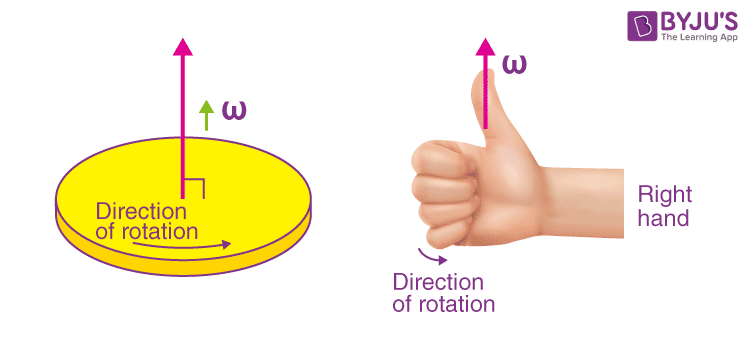
Angular velocity is a vector quantity.
This means it has both:
- Magnitude
- Direction
The direction is determined using the right-hand rule.
To apply it:
- Curl your fingers in the direction of rotation.
- Point your thumb outward.
Your thumb shows the direction of angular velocity.
This concept is especially important in physics, robotics, aerospace engineering, and mechanical systems.
Average Angular Velocity
Average angular velocity describes the overall rate of rotation over a time interval.
Formula:
\omega_{avg}=\frac{\Delta\theta}{\Delta t}
Where:
- Δθ = change in angular displacement
- Δt = change in time
This is useful when rotation speed varies over time.
Instantaneous Angular Velocity
Instantaneous angular velocity measures rotational speed at a specific moment.
For example:
A car wheel speeding up or slowing down may have varying rotational speed.
The instantaneous value provides the exact angular velocity at one instant.
This concept is commonly used in advanced mechanics and engineering design.
Angular Velocity in Circular Motion
Circular motion is one of the most important applications of angular velocity.
Examples include:
- Satellites orbiting Earth
- Ferris wheels
- Rotating gears
- Wind turbines
- Clock hands
- Rotating machinery
In circular motion, angular velocity helps describe how quickly the object moves around its circular path.
Real-Life Examples of Angular Velocity
Ceiling Fans
When a fan rotates, each blade sweeps through an angle over time.
The faster the fan setting, the greater the angular velocity.
Car Wheels
As a car accelerates, wheel rotation increases.
Engineers use angular velocity to calculate wheel performance and vehicle dynamics.
Earth’s Rotation
Earth rotates once every 24 hours.
This rotation creates an angular velocity that influences day and night cycles.
Wind Turbines
Wind turbine blades rotate because of wind energy.
Their angular velocity determines power generation efficiency.
Hard Drives
Computer hard drives rotate at high speeds.
Angular velocity affects data access performance and storage efficiency.
Angular Velocity in Engineering
Engineering relies heavily on angular velocity.
Applications include:
- Mechanical engineering
- Automotive engineering
- Aerospace engineering
- Robotics
- Industrial machinery
- Manufacturing systems
Engineers use angular velocity calculations to design safer and more efficient machines.
For example:
- Aircraft turbines require precise rotational speeds.
- Robotic arms depend on controlled angular motion.
- Factory equipment uses rotational mechanics daily.
Angular Velocity and Angular Acceleration
Many people confuse angular velocity with angular acceleration.
They are different concepts.
Angular Velocity
Measures how fast rotation occurs.
Angular Acceleration
Measures how quickly angular velocity changes.
Formula:
\alpha=\frac{\Delta\omega}{\Delta t}
Where:
- α = angular acceleration
- Δω = change in angular velocity
- Δt = time interval
A spinning object speeding up has positive angular acceleration.
A spinning object slowing down has negative angular acceleration.
Importance of Angular Velocity in Physics
Angular velocity plays a central role in many physics topics:
- Rotational kinematics
- Rotational dynamics
- Centripetal force
- Torque
- Momentum
- Energy conservation
- Orbital mechanics
Without angular velocity, understanding rotational systems would be nearly impossible.
Common Mistakes Beginners Make
When learning angular velocity, beginners often make a few mistakes.
Forgetting to Convert Degrees to Radians
Most formulas require radians.
Always convert degrees before calculating.
Confusing Angular and Linear Velocity
Remember:
- Angular velocity = rotation rate
- Linear velocity = distance rate
Ignoring Direction
Angular velocity is a vector quantity, not just a number.
Direction matters.
Using Incorrect Units
Always check whether the answer should be in:
- rad/s
- rpm
- degrees/s
Key Terms Related to Angular Velocity
Understanding these related concepts can strengthen your knowledge:
- Rotational motion
- Circular motion
- Angular displacement
- Angular acceleration
- Rotational speed
- Tangential velocity
- Radius
- Centripetal acceleration
- Rotational inertia
- Torque
- Moment of inertia
- Kinematics
- Dynamics
- Revolutions per minute
- Rotational energy
- Mechanical motion
- Orbital velocity
- Rotating frame
- Spin rate
- Rotation axis
- Rotational mechanics
- Motion analysis
- Velocity vector
- Rotational frequency
- Period of rotation
- Oscillation
- Gyroscopic motion
- Rotating systems
- Mechanical engineering
- Physics principles
These terms are frequently encountered when studying angular velocity.
Frequently Asked Questions
Is Angular Velocity the Same as Speed?
No.
Angular velocity measures rotational motion, while speed usually refers to linear movement.
Can Angular Velocity Be Negative?
Yes.
The sign depends on the direction of rotation.
Clockwise and counterclockwise rotations often use opposite signs.
Why Are Radians Used?
Radians simplify mathematical calculations involving circles and rotational dynamics.
What Is Constant Angular Velocity?
Constant angular velocity means the rotational speed remains unchanged over time.
A clock’s second hand is a good example.
Does Radius Affect Angular Velocity?
Not directly.
However, radius affects linear velocity through the equation:
v = rω
Quick Summary Table
| Concept | Meaning |
| Angular Velocity | Rate of rotational motion |
| Symbol | ω |
| SI Unit | rad/s |
| Formula | Angular displacement ÷ time |
| Type | Vector quantity |
| Related Concept | Angular acceleration |
| Applications | Physics, engineering, machinery, astronomy |
Why Learning Angular Velocity Matters
Understanding angular velocity does more than help you pass physics exams.
It explains many everyday phenomena:
- Why wheels rotate
- How fans work
- How turbines generate electricity
- Why planets orbit
- How amusement rides function
- How engines operate
Once you understand angular velocity, the mechanics behind countless devices become easier to visualize.
Moreover, this concept forms the foundation for advanced topics such as rotational dynamics, fluid mechanics, robotics, aerospace technology, and mechanical design.
Conclusion
Angular velocity is one of the fundamental concepts in rotational motion. It describes how quickly an object rotates around an axis and serves as a critical measurement in physics, engineering, astronomy, and countless real-world applications. From spinning bicycle wheels and ceiling fans to wind turbines and planetary motion, angular velocity helps explain the behavior of rotating systems all around us.